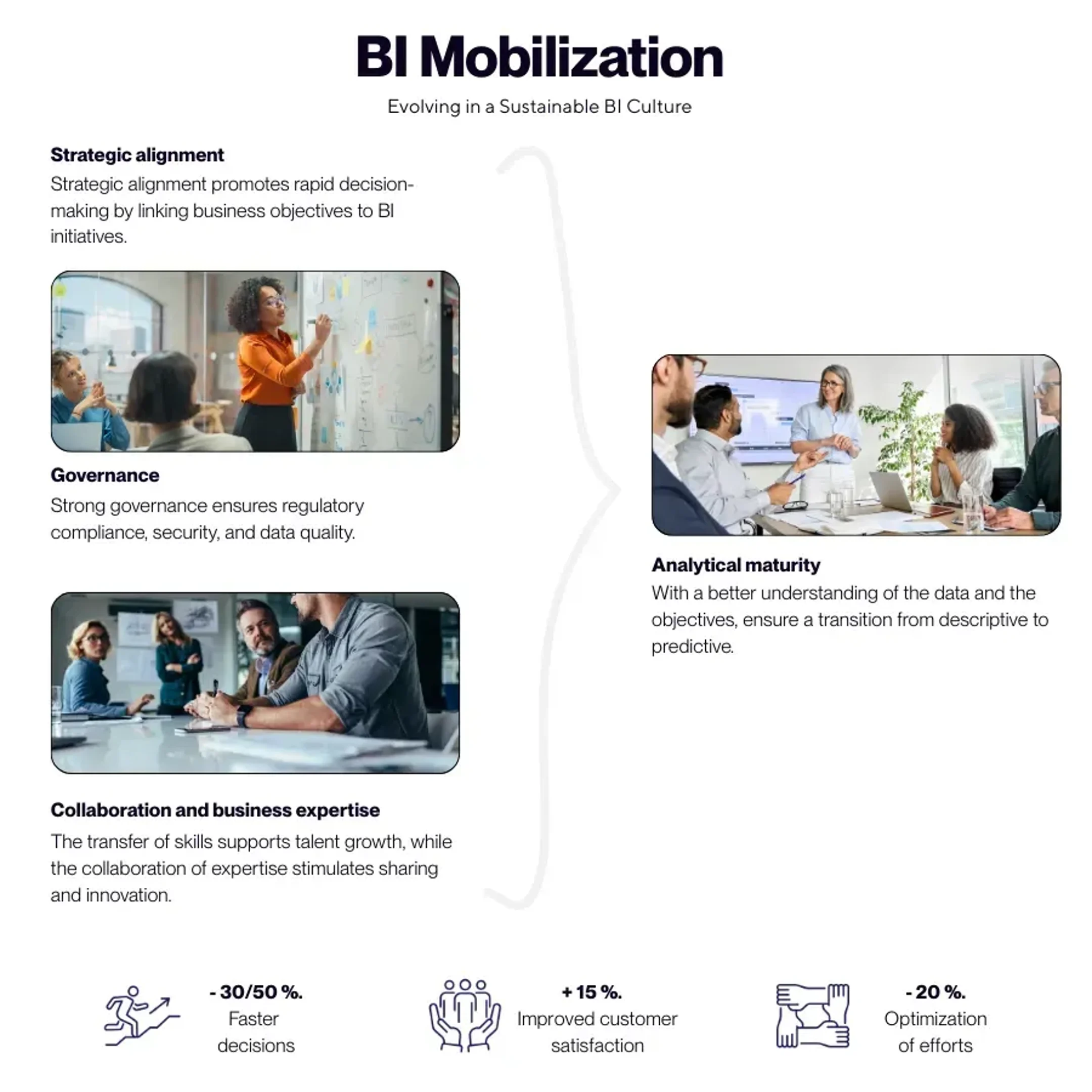
Turning complexity into executable simplicity.
In a context where data sits at the heart of strategic decision-making, business intelligence (BI) is no longer just about using a technological tool to create dashboards. It represents a true understanding of data that influences performance, governance, and innovation capacity. BI has become a transformation lever to better align organizational performance.
Yet the challenge is clear: how do you combine an ambitious vision with concrete execution that mobilizes the entire organization?
The answer can be summed up in one sentence: “Your role is to turn complexity into executable simplicity.”
A direct impact on competitiveness
A strong BI culture transforms how an organization makes decisions. It enables a shift from a reactive mindset to a proactive approach, where every decision is based on reliable, shared data.
By embedding BI into the business strategy, organizations gain agility. They can anticipate trends, quickly identify opportunities, and reduce risks linked to uncertainty. This ability to act with speed and precision becomes a major competitive advantage in markets where decision quality and timing make all the difference..
Why is this culture difficult to establish?
Several factors explain why building a BI culture remains challenging:
- It often seems easier to work in isolation. Organizational silos and data islands limit data circulation.
- BI is frequently viewed as an IT project, when it should be treated as an enterprise-wide initiative.
- Some organizations struggle with low confidence in the quality of their data.
- Analytical maturity varies widely. Some organizations are still operating at an “Excel” stage, while others are already integrating AI and predictive analytics.