Go to content

Data Engineering: The Engine of Your Digital Transformation

Digital transformation has become a strategic priority for organizations that want to improve performance, stay competitive, and deliver better experiences.

2026.02.04
Architecture, design, and solution implementation
5 min. reading

Digital transformation has become a strategic priority for organizations that want to improve performance, stay competitive, and deliver better experiences. But transformation requires a data-driven culture and the ability to manage and use information effectively.

Most organizations generate large amounts of data across multiple systems (CRM, ERP, IoT sensors, social platforms, etc.), yet struggle to leverage it. Without high-quality, well-structured data, it becomes nearly impossible to measure progress or make informed decisions. As the Institut intelligence et données (IID) of Université Laval reminds us:

“Without data, there is no AI. And even when data exists, it is often poorly organized or structured.”

This is where data engineering plays a central role. It equips organizations with the tools, processes, and architectures needed to store, integrate, transform, and prepare data so it can be translated into meaningful insights.

This article introduces the core activities that define the discipline of data engineering and how they support digital transformation efforts.

Operational and Analytical Needs.

Data engineering must support two essential categories of needs:

Operational Needs
These relate to day-to-day activities. Teams need timely, sometimes real-time, access to data to generate reports or monitor operations.

Analytical Needs
These involve integrating historical and multi-source data to create information layers, dashboards, and indicators that help organizations track performance, identify trends, and understand how processes evolve.

When operational and analytical needs are well supported, organizations can confidently advance toward machine learning and artificial intelligence initiatives.
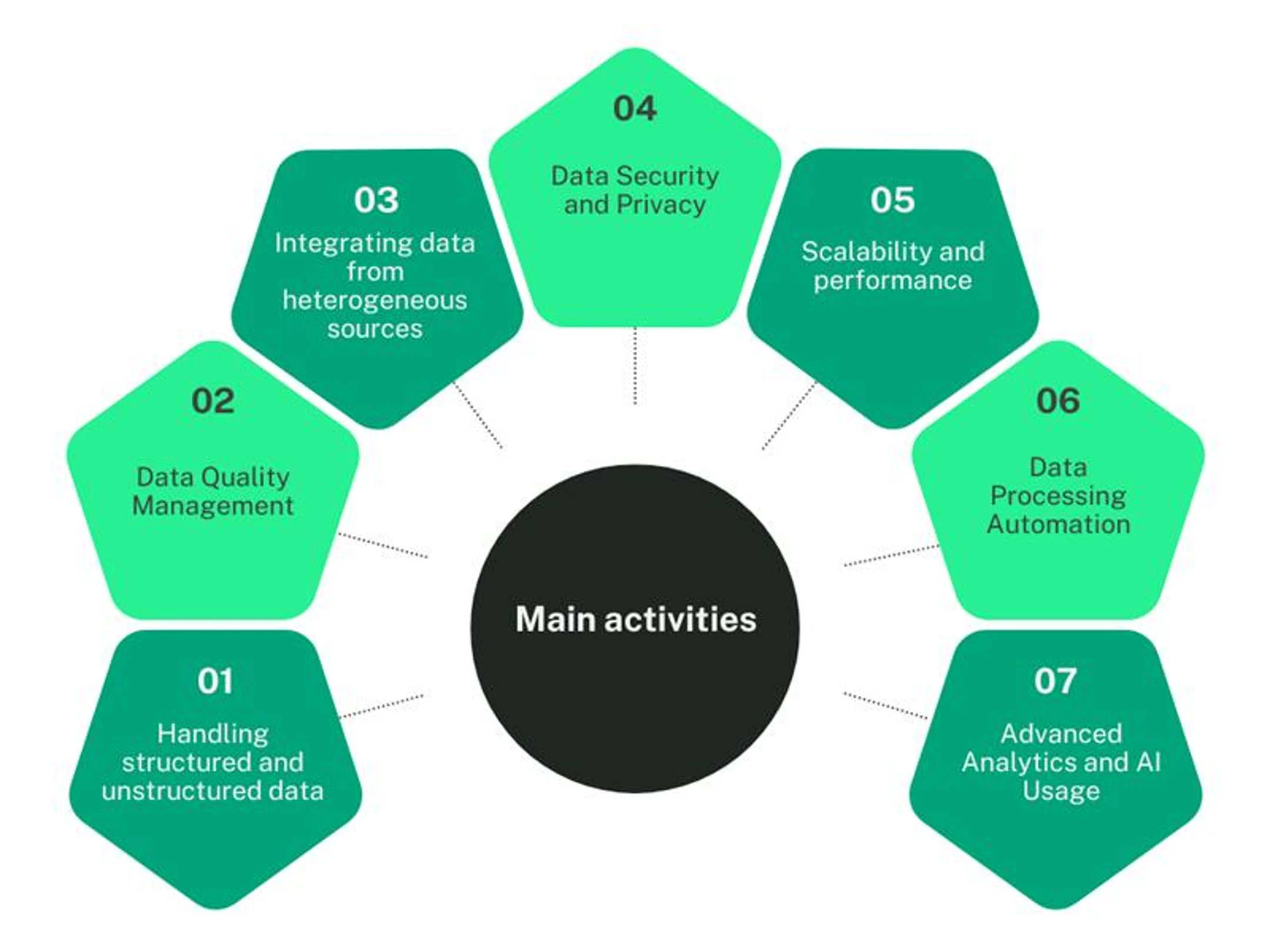

The Core Activities of Data Engineering.

Main activities of a digital transformation.

Whether it is enabling operations or analytics, data engineering typically involves seven key activities:

01 — Managing Structured and Unstructured Data

Structured data (databases, CSV files) follows a predefined model. Unstructured data (text, images, video) requires different technologies and methods to process and analyze effectively.

02 — Ensuring Data Quality

Data is often incomplete, inconsistent, or poorly formatted. One of the most critical responsibilities of data engineering is to ensure that the data used for decision-making is clean, reliable, and trustworthy.

03 — Integrating Data from Heterogeneous Sources

Organizations operate many systems. Data engineering makes it possible to connect them by cleaning, validating, and transforming data so it can be used seamlessly across platforms.

04 — Securing and Protecting Sensitive Information

Data security is essential. Organizations must comply with regulatory requirements and protect sensitive information throughout its lifecycle, from ingestion to analysis.

05 — Scaling Infrastructure and Ensuring Performance

As data volumes grow, systems must support large workloads and complex requests, often in near real-time. Data engineering builds scalable architectures that maintain performance under pressure.

06 — Automating Data Pipelines

Automating ingestion, transformation, and loading (ETL/ELT) processes reduces manual effort, accelerates delivery, and ensures data stays up to date, which is a critical enabler for AI and ML.

07 — Enabling Advanced Analytics and AI

Clean, well-structured data is the foundation of advanced analytics and artificial intelligence. Data engineering builds the environments required to train and operate AI models responsibly and effectively.

Conclusion

Data engineering is a core pillar of data governance and a critical enabler of digital transformation. As organizations generate more data and increase their reliance on analytics, they must address challenges related to data volume, quality, security, and strategic use.

Those that invest in robust data engineering capabilities are better positioned to unlock the full value of their data, support informed decision-making, and stay competitive in an increasingly data-driven world.

Author
Bernard Gosselin, Architect

Artificial intelligence tools were used to support the creation of this content.

You have a project?

Explore new ways to unlock the full value of your data and accelerate your transformation.

Talk to an expert.
COFOMO - Transformation numérique et intelligence artificielle - Approche collaborative - Femme souriante collaborant avec un client près d'une fenêtre.

About COFOMO

With over 30 years of recognized expertise, COFOMO stands as a leading Canadian firm in digital and artificial intelligence. From strategic consulting to solution architecture and operational support, we are the driving force behind the initiatives that elevate productivity, competitiveness, and growth for forward-thinking organizations.