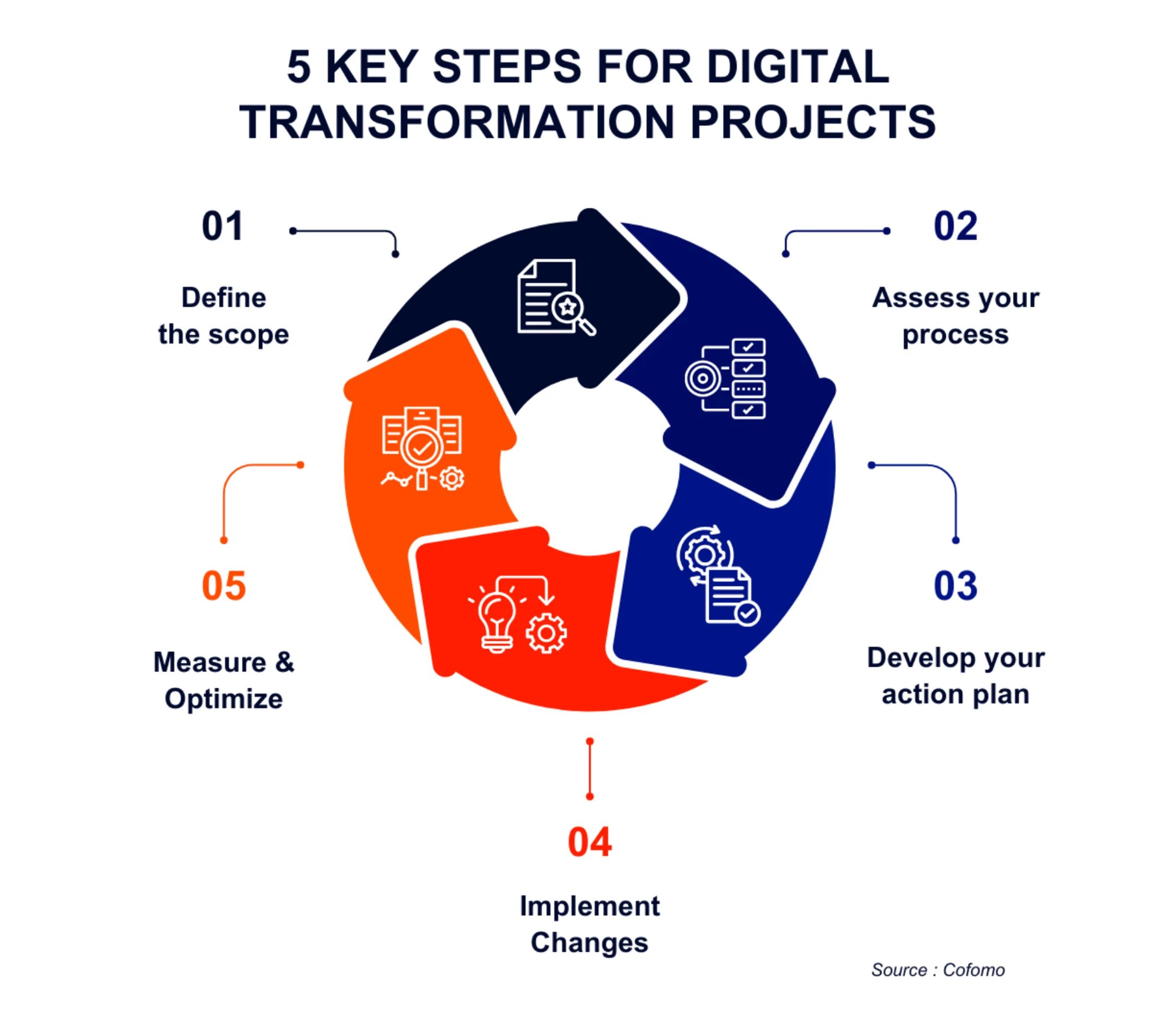
Digital transformation is crucial for modern businesses, for fostering innovation, competitiveness, and efficiency, while meeting the growing expectations of customers.
In a 2023 survey, 95% of the respondents said they had adopted a digital-first strategy: 66% had already adopted it and 29% had plans to do so. For many reasons.
Thinking of starting your digital transformation?
Go ahead! Here's why:
Improve operational efficiency and profitability
Digitized processes enable you to gain unmatched efficiencies by streamlining work. It can eliminate the need for multiple entries of the same data and reduce the risk of manual errors and produce real-time data that enables you to make faster, data-driven decisions to nip negative situations in the bud.
Let’s say your company is part of an ecosystem of interdependent enterprises, such as in the healthcare system. The use of cutting-edge digital tools, such as electronic health records (EHR), makes it easier to exchange information at a much higher speed, with radically less paperwork, and greater freedom from error. This delivers a win-win for both company and patient.
Increase revenue from customers
For B2B and B2C companies, the cost of customer acquisition has climbed significantly over the last ten years. Churn rates, too, are increasing, which raises the pressure on enterprises to enhance customer retention and increase the number and size of customer purchases.
That’s where digital tools, including analytics and AI, can help. Data tools can provide insight into customer behaviour, simplify the forecasting of demand, and enable your sales and marketing teams to make more personalized communications to boost customer conversions.
Create better customer experiences
The rising quality of online consumer experiences raises customer expectations in all industry sectors. Your customers now expect personalized experiences that show you’ve been paying attention to their needs, preferences, and habits.
For example, customers want answers to their questions, 24/7. Fluid, automated 24/7 self-service becomes possible with AI-enabled chatbots. They can answer queries conversationally or explain to customers how to use your product or service effectively.
The challenges of digital transformation
The discussion above only touches on the vast list of efficiencies and growth digital transformation makes possible. So, it’s not surprising that 95% of enterprises are choosing a digital-first path.
What may be surprising is that, according to the Boston Consulting Group, 70% of enterprises feel that their digital transformations fall short of their objectives.
What do digital transformations entail, and why do some fail to live up to their promises?
3 different scales of digital transformation
Integrating technology and digital tools into your enterprise’s ways of working can be done at different scales. On the smaller end, we have digital optimization projects, where you aim for the near-term benefits that come with initiatives such as:
- Migrating workloads to the cloud to benefit from state-of-the-art tools, such as generative AI, advanced analytics, and automation, as well as to promote seamless collaboration across the enterprise.
- Replacing legacy software or outdated technology to minimize maintenance costs, integrate newer software for greater capabilities, and improve the customer experience.
- Optimizing business processes to reduce manual inputs and routine repetitive tasks, thus freeing up your team for higher-value tasks.
On the other end of the transformation spectrum, a large-scale digital transformation can be carried out to enter a new market or compete in new ways. Take for example Microsoft in the 2000s. Microsoft’s share price was taking a beating due to competitive pressure from Amazon, Apple, and other companies.
To up its game, Microsoft changed its strategy and built cloud capacity to offer clients what was initially conceived as software-as-a-service. This change of direction has paid off.
7 reasons why many digital transformations don’t live up to their promise
Based on our nearly 30 years of experience in digital transformations, the following key factors can contribute to disappointed expectations:
1. Overly ambitious projects and scope creep
From day one, the enterprise does not have a focused scope for its digital transformation. Worse yet, as the project evolves, it gains new requirements and features that result in delays and budget overages.
2. Misalignment
Smaller digital optimization projects are given the go-ahead without considering how they align with the enterprise’s strategic goals.
Or the digital project is not focused on a process, business unit, or part of the customer journey with high potential for adding value to the company.
3. Lack of commitment and accountability
Digital transformation represents long-term change. To drive projects with such far-reaching implications for a company takes an executive team fully committed to, and accountable for, project success.
4. Runaway costs
After a project scope is defined, IT teams are often asked to deliver more, faster, which drives up costs. In a study of nearly 5,400 IT projects, 18% had cost overruns above 50%.
5. Talent and resource shortages
The company may underestimate the level of resources or talent needed to support a digital transformation. Project managers need adequate resources to do the job.
6. Disengaged employees
Digital transformation is uncomfortable because it demands learning new tools, knowledge, and ways of working. Employee disengagement can be damaging to the project's success.
7. Insufficient investment in change management
Digital transformation involves learning in numerous facets of work. Companies that underestimate the investment in coaching, support, and communications needed to shift employee mindsets will likely have disappointing transformations.